Neurodiversity Celebration Week
Celebrating different minds and different ways of thinking
Rocky Pellegrino - 16/03/2026
3 min read
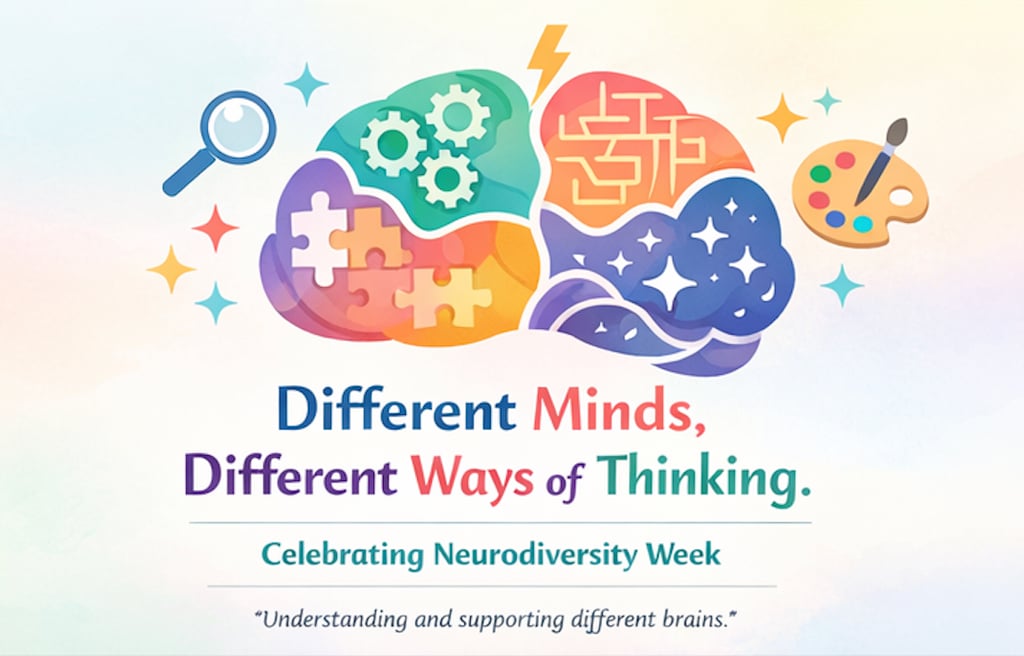
Celebrating Neurodiversity Week: Different Minds, Different Ways of Thinking
Each year, Neurodiversity Celebration Week reminds us of something important:
There is no single “correct” way for a brain to work.
Human brains naturally vary in how they process information, notice patterns, regulate attention, communicate, and experience the world. Some people think quickly and verbally. Others think visually or spatially. Some people need more time to process information but develop deep insight or creativity. Others thrive on novelty, movement, and exploration.
These differences are part of neurodiversity.
Rather than viewing these differences as problems to be fixed, the neurodiversity perspective recognises that variation in human thinking is natural and valuable.
What is neurodiversity?
Neurodiversity refers to the natural variation in human brains and cognitive styles.
It includes people whose brains work in ways commonly described as:
Autistic
ADHD
Dyslexic
Dyspraxic
Tourette’s
Gifted
And many other forms of cognitive diversity
Historically, many of these differences have been described almost entirely in terms of deficits or impairments.
But this perspective often reflects a mismatch between the individual and their environment, rather than something inherently “wrong” with the person.
A neurodiversity perspective asks a different question:
What happens when environments are designed for only one way of thinking?
Differences are often framed as deficits
Many common descriptions of neurodivergence focus heavily on what someone struggles with:
“poor attention”
“impaired social skills”
“slow processing”
“deficits in executive functioning”
Yet these descriptions often overlook something important.
Many of the same traits that create challenges in one environment can be strengths in another.
For example:
A brain that processes information deeply may appear “slow” in time-pressured environments but can produce thoughtful, detailed insights.
A person who notices small details others miss may struggle with noisy classrooms but excel in pattern recognition or analytical thinking.
Someone who communicates directly may be misunderstood in socially complex environments but bring honesty and clarity to relationships.
In other words, the context matters.
Neurodivergent brains often bring valuable perspectives
Many neurodivergent individuals contribute unique ways of thinking, such as:
Pattern recognition and systems thinking
Many autistic and ADHD individuals notice relationships and patterns others miss.
Creativity and divergent thinking
Different cognitive styles often support innovative problem-solving and novel ideas.
Deep interest and expertise
Strong interests can lead to exceptional knowledge and skill in specific areas.
Authenticity and fairness
Many neurodivergent people place strong value on honesty, justice, and consistency.
These strengths are not separate from neurodivergence, they are often part of the same cognitive profile.
Support should remove barriers, not erase identity
Recognising strengths does not mean ignoring real challenges.
Many neurodivergent individuals experience genuine difficulties, including:
sensory overload
environments that move too quickly
expectations around social communication
executive functioning demands
rigid or unpredictable systems
However, neurodiversity-affirming support focuses on reducing barriers rather than changing the person’s brain.
This can involve:
allowing more processing time
adjusting sensory environments
providing clearer expectations
supporting regulation strategies
recognising communication differences
building on individual interests and strengths
When environments adapt, neurodivergent people are often able to participate, contribute, and thrive.
Moving beyond “fixing” people
For many years, support approaches focused on trying to make neurodivergent individuals appear more “typical”.
Increasingly, families, educators, and clinicians are recognising that this approach can create pressure to mask natural ways of thinking and being.
Masking can help someone fit in temporarily, but over time it is associated with exhaustion, anxiety, and burnout.
A neurodiversity-affirming approach instead focuses on:
understanding how a person’s brain works
supporting authentic communication and regulation
creating environments where different thinking styles are respected
When people feel understood and accepted, they are far more likely to develop confidence, wellbeing, and meaningful relationships.
Why Neurodiversity Celebration Week matters
Neurodiversity Celebration Week invites us to reflect on an important shift in thinking.
Instead of asking:
“How do we change this person?”
We might ask:
“How can we design environments where different minds can succeed?”
When schools, workplaces, and communities embrace neurodiversity, we move closer to a world where:
differences are recognised as part of human diversity
support focuses on removing barriers
strengths and perspectives are valued
and people do not need to hide who they are in order to belong.
At Affirmative Minds Psychology
At Affirmative Minds Psychology, we work with children, adolescents, and adults using neurodiversity-affirming approaches.
Our focus is not on changing who someone is, but on helping individuals understand their brain, develop supportive strategies, and build environments where they can thrive.
Because every mind deserves to be understood!
References
Armstrong, T. (2010). The Power of Neurodiversity. Da Capo Press.
Chapman, R. (2021). Neurodiversity and the social ecology of mental functions. Perspectives on Psychological Science, 16(6), 1360–1372.
Singer, J. (1999). Why can’t you be normal for once in your life? From a problem with no name to the emergence of a new category of difference.
Affirmative Minds Psychology
Affirming identities and amplifying voices for a brighter tomorrow.
© 2024. All rights reserved.
Affirmative Minds Psychology is a neuro-affirming psychology clinic in Watsonia, offering counselling, therapy and assessments for children, teens, adults and families. We support clients across Bundoora, Greensborough, Macleod, Rosanna, Heidelberg, Viewbank and Melbourne’s northern suburbs. Services include ADHD assessment, Autism assessment, child psychology, adult psychology, couples counselling, cognitive testing and animal-assisted therapy.
Affirmative Minds Psychology acknowledges the Wurundjeri Woi-wurrung people as the Traditional Custodians of the land on which we work and live. We pay our respects to their Elders past, present and emerging, and honour their continuing cultural and spiritual connection to the land, waters, and community.
Affirmative Minds Psychology celebrates, values and includes people of all backgrounds, genders, sexualities, cultures, bodies and abilities.