Inclusion Isn’t About Fixing the Child
Why environmental change must come first for autistic and ADHD students
Rocky Pellegrino - 23/02/2026
5 min read
Inclusion Isn’t About Fixing the Child
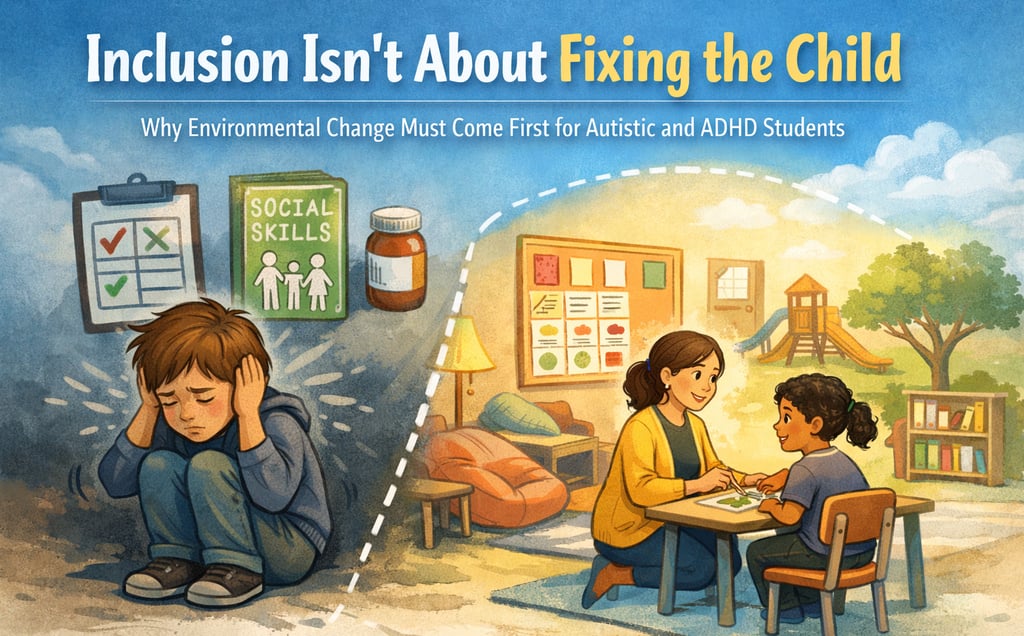
When a neurodivergent student struggles at school, the first question is often. “What does this child need to learn to cope better?”
Social skills training.
Emotion regulation programs.
CBT.
Behaviour charts.
Medication.
These supports can be helpful. But here’s the uncomfortable truth emerging clearly from the research:
Most interventions still try to change the student — even when the environment is the real barrier.
Large reviews of inclusive education for autistic students show that we overwhelmingly target internal change, despite strong calls from researchers and lived-experience consultants to prioritise environmental adaptation instead (e.g., Autism; Autism & Developmental Language Impairments).
When we actually listen to autistic young people? They tell us mainstream schools are often:
Noisy
Crowded
Unpredictable
Socially unsafe
Resulting in significant impacts on anxiety, behaviour, attendance, and mental health.
So perhaps the better question is: What does the school need to change?
Behaviour Is an Interaction — Not a Defect
Behaviour and engagement don’t exist in isolation. They emerge from the interaction between:
The student’s neurology
The classroom environment
The relational climate
The sensory load
The instructional structure
When a student is overwhelmed, dysregulated, inattentive or avoidant, that is often a signal of environment–learner mismatch, not defiance or deficit.
What Environmental Change Actually Looks Like
Environmental adjustment is not about lowering expectations. It is about removing unnecessary barriers so students can meet them.
1. Sensory & Physical Adjustments
Research consistently shows that changes to the sensory and physical environment reduce anxiety, tantrums, and inattention, while improving participation. Effective adjustments include:
Access to quiet or retreat spaces
Smaller learning groups where possible
Predictable classroom layouts
Controlled lighting and noise levels
Sensory autonomy (choice over environmental input)
These are not luxuries. They are access supports.
2. Instructional Clarity & Structure
Structure reduces cognitive load. Studies of inclusive practice highlight that autistic and ADHD students benefit from:
Clear, consistent routines
Visual schedules
Explicit step-by-step instructions
Chunked tasks
Flexible workload and assessment options
These approaches improve engagement and reduce challenging behaviour — and are particularly important for students experiencing school avoidance.
Clarity is not “special treatment.” It is good teaching.
3. Autonomy & Relationships
Perhaps most powerful of all is the relational environment.
Research examining teacher–student interactions shows that autonomy-supportive teaching (where students feel understood, respected, and given appropriate choice) predicts stronger engagement for autistic adolescents.
Similarly, educators report that ADHD support must be relationship-based and individualised, not reliant solely on medication or demands for self-control.
A trusted adult in the building can be the difference between attendance and avoidance. Belonging precedes behaviour change.
What About Internal Skills?
Internal skills interventions are not useless. Self-management strategies, CBT adaptations, and behaviour-analytic supports can improve:
On-task behaviour
Compliance
Emotion regulation
Physical activity
Specific behavioural goals
But there is a crucial caveat: These approaches are most effective when paired with environmental support.
Autistic students consistently report that when sensory overload, bullying, or deficit framing remain unchanged, they are simply learning to mask or endure, not thrive.
We cannot teach coping skills for conditions that should not exist in the first place.
The Ethical Order of Operations
If we summarise the evidence, a clear hierarchy emerges:
First: Adjust the environment.
Reduce sensory stress. Increase clarity. Strengthen relationships.Second: Scaffold internal skills.
Support regulation, executive function, and coping (within a safe system).Avoid: Expecting the child to adapt to an unchanged, overwhelming setting.
When we reverse that order, we risk:
Increasing anxiety
Reinforcing shame
Encouraging masking
Mistaking survival for success
Inclusion Is a System Responsibility
For autistic and ADHD students in mainstream schools, behaviour is not a character flaw. It is data.
The research across multiple disciplines is remarkably consistent: Engagement improves when environments are predictable, relationally safe, and sensory-considerate.
Inclusion is not achieved by teaching children to tolerate distress quietly. It is achieved by designing systems that reduce unnecessary distress.
Final Reflection
When a neurodivergent student is struggling, instead of asking:
“How do we make this child cope better?”
We might ask:
“What in this environment is asking too much?”
At Affirmative Minds Psychology, we work with families and schools to prioritise environmental and relational adjustments first, then build internal skills within that foundation.
Because students should not have to change who they are to access education. They should be supported by systems willing to evolve.
References
Lory, C., Gregori, E., Huff, S., Lee, R., & Rendon, N. (2024). Interventions for challenging behavior of autistic students in general education settings: A systematic literature review. Research in Autism Spectrum Disorders. https://doi.org/10.1016/j.rasd.2024.102385
Imasaka, T., Lee, P., Anderson, A., Wong, C., Moore, D., Furlonger, B., & Bussaca, M. (2020). Improving Compliance in Primary School Students with Autism Spectrum Disorder. Journal of Behavioral Education, 29, 763-786. https://doi.org/10.1007/s10864-019-09346-5
Vantić-Tanjić, M., Nikolić, M., Chabukovski, V., Zorcec, T., Subotić, M., Jeličić, L., Vantić-Tanjić, I., Mehmedinović, S., Zlatkovski, D., Zorchec, D., Kadam, C., Terekli, P., & Yildiz, Y. (2025). EFFECTIVE STRATEGIES FOR ADDRESSING AUTISTIC BEHAVIOURS AND LEARNING BARRIERS: SYSTEMATIC LITERATURE REVIEW. Research in Education and Rehabilitation. https://doi.org/10.51558/2744-1555.2025.8.1.252
Chapman, H., Southall, A., & Grieshaber, S. (2025). What autistic students say about their learning and teaching experiences in mainstream secondary school: a scoping review. The Australian Educational Researcher, 52, 2821 - 2848. https://doi.org/10.1007/s13384-025-00838-0
Petersson-Bloom, L., & Holmqvist, M. (2022). Strategies in supporting inclusive education for autistic students—A systematic review of qualitative research results. Autism & Developmental Language Impairments, 7. https://doi.org/10.1177/23969415221123429
Nurhidaya, N., & Purwanta, E. (2025). Managing Temper Tantrums in Autistic Middle School Students. Journal of Innovation and Research in Primary Education. https://doi.org/10.56916/jirpe.v4i3.1943
Perrelet, V., Veyre, A., Chawki, L., Margot, C., & Cappe, É. (2025). What are we targeting when we support inclusive education for autistic students? A systematic review of 233 empirical studies and call for community partnerships. Autism, 29, 2927 - 2940. https://doi.org/10.1177/13623613251352223
Fitri, A., Dewi, W., Hamidy, M., & Saam, Z. (2025). The autistic child friendly school environment model for behavioral development in children with autism. Journal of Education and Health Promotion, 14. https://doi.org/10.4103/jehp.jehp_58_25
Qutub, R., Luo, Z., Vasilikou, C., Tavassoli, T., Essah, E., & Marcham, H. (2024). Impacts of school environment quality on autistic pupil's behaviours – A systematic review. Building and Environment. https://doi.org/10.1016/j.buildenv.2024.111981
Villegas, F., Van Der Steen, S., Van Dijk, M., Villegas, D., & Minnaert, A. (2025). Teacher-Student Interactions of Autistic Adolescents: Relationships between Teacher Autonomy Support, Structure, Involvement and Student Engagement.. Journal of autism and developmental disorders. https://doi.org/10.1007/s10803-025-06723-0
Moore, D., Russell, A., Arnell, S., & Ford, T. (2017). Educators' experiences of managing students with ADHD: a qualitative study. Child: Care, Health and Development, 43, 489–498. https://doi.org/10.1111/cch.12448
Unwin, K., Powell, G., & Jones, C. (2021). The use of Multi-Sensory Environments with autistic children: Exploring the effect of having control of sensory changes. Autism, 26, 1379 - 1394. https://doi.org/10.1177/13623613211050176
Horgan, F., Kenny, N., & Flynn, P. (2022). A systematic review of the experiences of autistic young people enrolled in mainstream second-level (post-primary) schools. Autism, 27, 526 - 538. https://doi.org/10.1177/13623613221105089
Machalicek, W., O’Reilly, M., Beretvas, N., Sigafoos, J., & Lancioni, G. (2007). A review of interventions to reduce challenging behavior in school settings for students with autism spectrum disorders. Research in Autism Spectrum Disorders, 1, 229-246. https://doi.org/10.1016/j.rasd.2006.10.005
O’Hagan, S., Bond, C., & Hebron, J. (2022). Autistic girls and emotionally based school avoidance: supportive factors for successful re-engagement in mainstream high school. International Journal of Inclusive Education, 28, 1919 - 1935. https://doi.org/10.1080/13603116.2022.2049378
Parsons, K., Payne, S., Bhaska, L., Wallace, J., & Holt, N. (2025). A systematic review of behaviour change techniques employed in interventions aimed to change physical activity behaviour in autistic individuals.. Psychology of sport and exercise, 102867. https://doi.org/10.1016/j.psychsport.2025.102867
Aubineau, M., & Blicharska, T. (2020). High-Functioning Autistic Students Speak About Their Experience of Inclusion in Mainstream Secondary Schools. School Mental Health, 12, 537 - 555. https://doi.org/10.1007/s12310-020-09364-z
Affirmative Minds Psychology
Affirming identities and amplifying voices for a brighter tomorrow.
© 2024. All rights reserved.
Affirmative Minds Psychology is a neuro-affirming psychology clinic in Watsonia, offering counselling, therapy and assessments for children, teens, adults and families. We support clients across Bundoora, Greensborough, Macleod, Rosanna, Heidelberg, Viewbank and Melbourne’s northern suburbs. Services include ADHD assessment, Autism assessment, child psychology, adult psychology, couples counselling, cognitive testing and animal-assisted therapy.
Affirmative Minds Psychology acknowledges the Wurundjeri Woi-wurrung people as the Traditional Custodians of the land on which we work and live. We pay our respects to their Elders past, present and emerging, and honour their continuing cultural and spiritual connection to the land, waters, and community.
Affirmative Minds Psychology celebrates, values and includes people of all backgrounds, genders, sexualities, cultures, bodies and abilities.