When Support Becomes Suspicion: Moral Panic and the NDIS Narrative
When does scrutiny become suspicion? This article breaks down how moral panic forms, why recent NDIS coverage is heavily weighted toward risk and cost, and how a single statistic can reshape public understanding of an entire system.
Rocky Pellegrino - 21/04/2026
4 min read

When Support Becomes Suspicion: Moral Panic and the NDIS Narrative
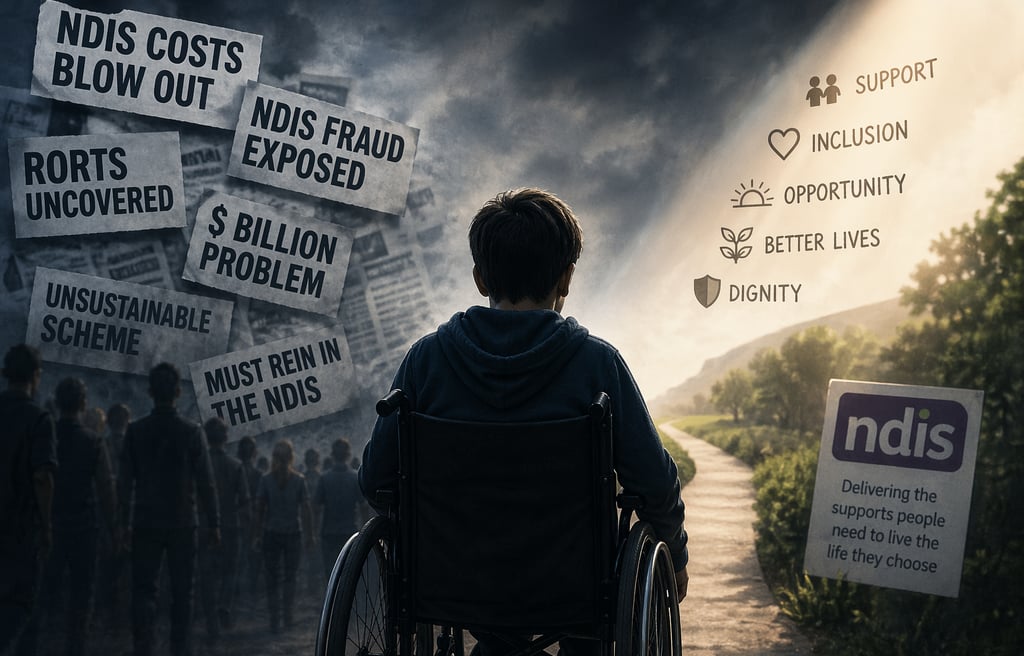
Public discussion of the National Disability Insurance Scheme (NDIS) has shifted.
Recent coverage has increasingly focused on cost blowouts, sustainability concerns, and system misuse. These are legitimate areas of scrutiny. Large public systems require accountability.
But taken together, the pattern raises a different kind of question:
Are we seeing a balanced picture of the NDIS, or the early stages of a moral panic?
Understanding Moral Panic
Moral panic is a well-established sociological concept used to describe how public concern can escalate around a perceived social problem.
It does not require misinformation, and it does not depend on bad actors.Instead, it emerges through patterns of emphasis.
Typically, moral panic follows a recognisable sequence:
1. A real issue is identified
For the NDIS, this includes rising costs, isolated misuse, and questions of long-term sustainability.
2. The issue is simplified into compelling signals
Complex systems are reduced to headline-ready elements (i.e., large numbers, sharp ratios, and clear narratives of risk).
3. These signals are amplified
Media repetition prioritises what is most attention-grabbing: fraud, excess, and system strain.
4. Perception becomes disproportionate
Public understanding begins to reflect the most visible aspects of the issue, rather than its full context.
5. Pressure builds for control
The conversation shifts from support toward regulation, restriction, and containment.
At each stage, the underlying information may be accurate. What changes is the balance of what is seen, repeated, and remembered.
What the Current Media Pattern Shows
Recent coverage of the NDIS aligns closely with this pattern. In a rapid coded sample of 50 mainstream NDIS-related articles published over the past one to two months:
68% were predominantly framed around risk-related themes (fraud, cost blowouts, misuse, sustainability)
22% were mixed or reform-focused
10% primarily centred participant outcomes or lived experience
This was not a formal academic content analysis. However, the pattern was clear: coverage is dominated by narratives of risk and control, with comparatively limited attention to outcomes or everyday benefit.
This pattern does not make the reporting inaccurate. But it does shape the overall picture that reaches the public.
When most visible stories emphasise risk, even accurate reporting can cumulatively produce a perception that the system is primarily defined by its problems.
How a Single Number Can Shift Perception
Moral panic does not emerge from abstraction. It is built through specific, memorable signals.
One example illustrates this clearly.
A widely circulated report across several mainstream news sites suggested that a Sydney suburb had approximately 1,300 NDIS providers. This was framed in headlines as roughly one provider for every 13 residents.
This is a striking figure. It implies saturation, excess, and potential misuse. However, the number reflects something quite different.
It includes providers who are registered to deliver services to participants in that area, not providers physically based there. This includes:
providers located in other suburbs
providers delivering services remotely or online
providers covering broad geographic regions
In other words, it measures potential service reach, not local provider presence.
Analysis by Australian Associated Press found that when restricted to providers actively delivering services within the suburb, the number was 16.
This is a difference of roughly 80 times.
Both figures can be derived from the same system. But they do not describe the same reality. A figure of 1,300 suggests a system out of control. A figure of 16 suggests a small number of active providers.
This is how moral panic operates, not through falsehood, but through which version of reality becomes most visible.
From Support to Control
As these patterns accumulate, the narrative shifts.
Concern about sustainability becomes the dominant lens. Notably, many of the strongest statements describing the scheme as “unsustainable” come from the same institution responsible for managing and reforming it.
This is not inappropriate. Governments are tasked with maintaining system viability.
However, it creates a feedback loop:
concerns are identified
amplified through media
reinforced in public perception
and returned as justification for reform
Within this loop, emphasis matters. When the dominant narrative centres risk, cost, and misuse, the system itself begins to be understood primarily in those terms.
Why This Matters
For people with disability, the NDIS is not a theoretical system.
It is:
access to therapy
support for participation in education
assistance with daily living
a safeguard against escalation and crisis
When the narrative shifts from support to suspicion, the effects are not confined to media coverage.
They influence:
how individuals feel about accessing support
how families engage with services
how practitioners justify care
how policy decisions are shaped over time
These changes are gradual, but cumulative.
A Familiar Structure
Australia has seen similar patterns before.
Public discourse around welfare once became dominated by the idea of the “dole bludger”, a narrative that emphasised misuse over need.
Over time, this contributed to:
reduced public empathy
increased scrutiny
policy settings that prioritised compliance
The comparison is not exact. But the structure, from support to suspicion, is recognisable.
Holding Proportionality
None of this suggests that the NDIS should not be examined critically. Questions of sustainability, efficiency, and accountability are necessary. But they sit alongside another equally important question:
Are current narratives proportionate to the reality they describe?
When complex systems are reduced to their most alarming elements, perception can move ahead of context. A more balanced conversation requires:
attention to scale and framing
inclusion of lived experience
differentiation between systemic issues and isolated examples
recognition of both costs and outcomes
Final Thought
Moral panic does not depend on falsehood. It depends on visibility.
Which stories are told.
Which numbers are repeated.
Which perspectives are foregrounded.
Before accepting any dominant narrative, about disability, welfare, or public systems, it is worth asking:
Are we seeing the whole picture, or just the most visible part of it?
Affirmative Minds Psychology
Affirming identities and amplifying voices for a brighter tomorrow.
© 2024. All rights reserved.
Affirmative Minds Psychology is a neuro-affirming psychology clinic in Watsonia, offering counselling, therapy and assessments for children, teens, adults and families. We support clients across Bundoora, Greensborough, Macleod, Rosanna, Heidelberg, Viewbank and Melbourne’s northern suburbs. Services include ADHD assessment, Autism assessment, child psychology, adult psychology, couples counselling, cognitive testing and animal-assisted therapy.
Affirmative Minds Psychology acknowledges the Wurundjeri Woi-wurrung people as the Traditional Custodians of the land on which we work and live. We pay our respects to their Elders past, present and emerging, and honour their continuing cultural and spiritual connection to the land, waters, and community.
Affirmative Minds Psychology celebrates, values and includes people of all backgrounds, genders, sexualities, cultures, bodies and abilities.