Processing Speed: The Hidden Cognitive Bottleneck
Why Bright Kids and Adults Can Still Struggle to Keep Up
Rocco Pellegrino - 12/03/2026
5 min read
Processing Speed: The Hidden Cognitive Bottleneck
When people think about cognitive strengths and challenges, they often focus on things like intelligence, memory, or attention. But one of the most powerful and often overlooked cognitive abilities is processing speed.
Processing speed refers to how quickly the brain can take in information, understand it, and respond. It doesn’t measure intelligence. In fact, many very bright children and adults have slower processing speed. Yet it influences almost every area of daily functioning.
Alongside executive functioning, processing speed is one of the most pervasive cognitive domains affecting how people learn, work, and interact with the world. Importantly, processing speed also affects how efficiently executive functions operate, because executive processes rely on information being processed quickly enough to guide behaviour.
Understanding processing speed can help explain why some people appear capable but still struggle with school, work, or everyday demands.
What Is Processing Speed?
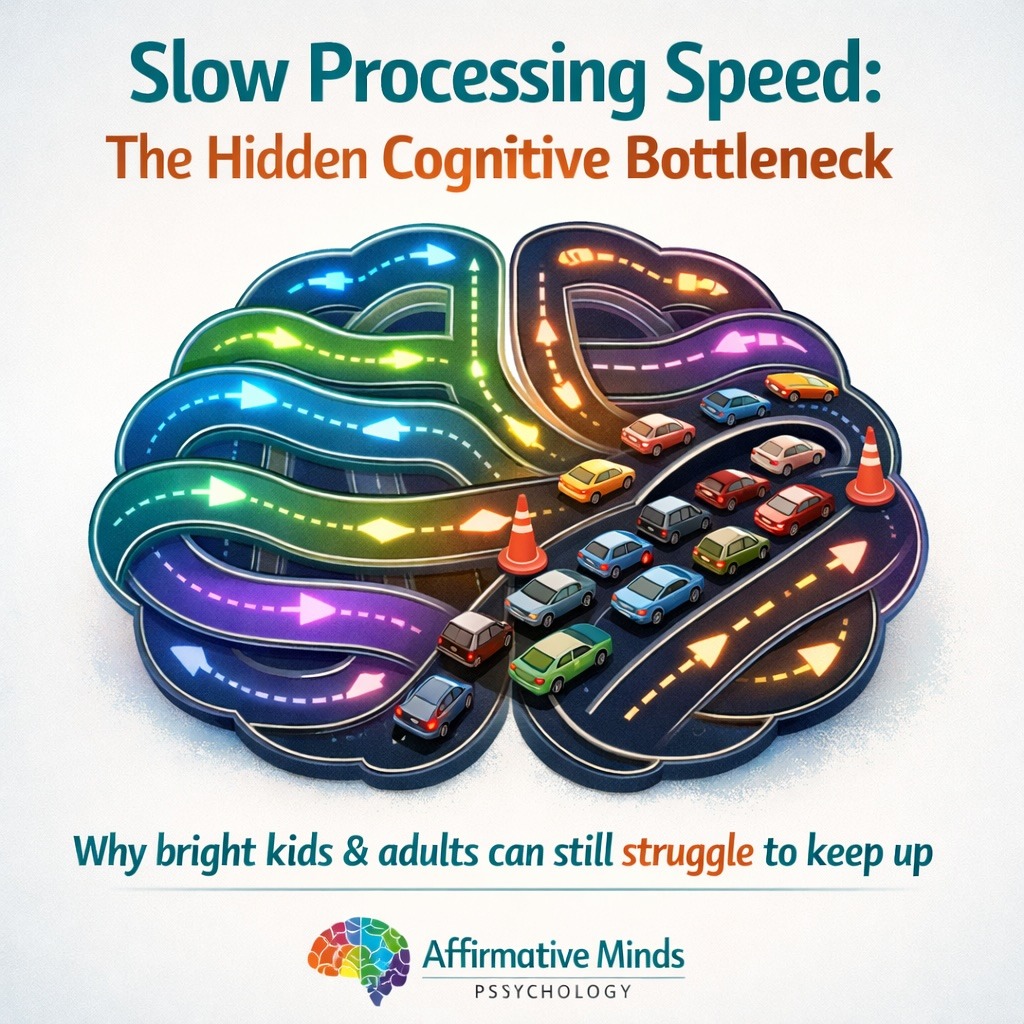
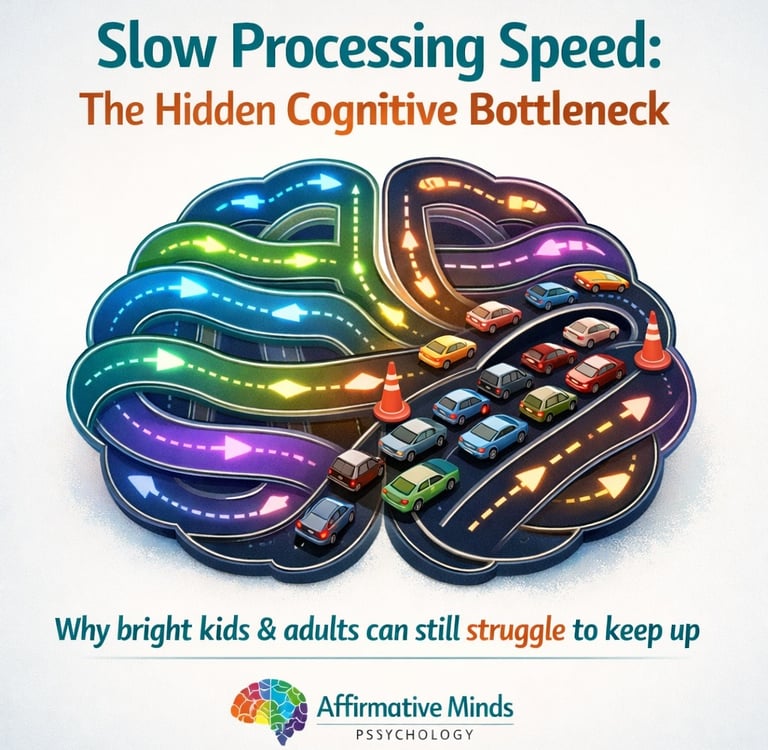
Processing speed is essentially the brain’s information throughput rate.
It affects how quickly someone can:
• understand instructions
• read and interpret information
• respond to questions
• complete written work
• switch between tasks
• integrate multiple pieces of information
If processing speed is slower, the person may still fully understand the material, but it simply takes longer to process and respond. Even in people with similar processing speeds to their peers, if they are deep thinkers, their processing speed can't keep up with other areas of cognition.
A helpful analogy is computer hardware: two computers may run the same software, but one has a slower processor. The output is still correct, it just takes longer.
Why Processing Speed Has Such a Large Impact on Functioning
Processing speed plays a foundational role in many other cognitive systems.
Research shows that slower processing speed can create bottlenecks in higher-order thinking, including executive functioning, working memory, and attention regulation. When information moves more slowly through cognitive systems, complex thinking becomes more effortful.
In practical terms, slower processing speed can make it harder to:
• keep up with classroom instruction
• manage multi-step tasks
• participate in fast conversations
• take notes while listening
• complete timed assessments
• juggle multiple pieces of information
Even when reasoning ability is strong, slower processing speed can limit how efficiently those abilities are expressed in real-world settings.
Because many environments reward speed of output, individuals with slower processing speed may appear less capable than they actually are.
Processing Speed and Executive Function
Processing speed and executive functioning are closely connected. Executive functions such as planning, working memory, and cognitive flexibility, rely on the brain’s ability to rapidly process incoming information and update responses.
If information processing is slower, executive processes may appear weaker simply because the system is operating more slowly.
For example: A child may struggle to follow multi-step instructions not because they cannot understand them, but because the information arrives faster than it can be processed and organised. Similarly, someone may appear forgetful or disorganised when the real issue is that working memory processes cannot keep up with incoming information.
This interaction helps explain why processing speed differences can affect such a wide range of skills.
Processing Speed in ADHD
Processing speed differences are commonly observed in individuals with ADHD.
Research suggests that ADHD is associated with differences in information processing efficiency, particularly in tasks requiring sustained attention and rapid responses. Slower processing speed can contribute to:
• difficulty keeping up with instructions
• slow task completion
• challenges integrating information quickly
• fatigue during sustained cognitive effort
However, ADHD often also involves high variability in response speed.
In other words, performance may fluctuate between very fast and very slow responses. This variability is a well-known feature of ADHD cognitive profiles and contributes to the sense that performance can be inconsistent across tasks.
For students with ADHD, this can result in a pattern where they understand concepts well but struggle with timed tasks or rapid classroom pacing.
Processing Speed in Autism
Many autistic individuals also show relatively slower processing speed, even when reasoning ability or verbal skills are strong. Research comparing ADHD and autism suggests that both groups may show differences in executive functioning and processing speed, but the patterns and underlying mechanisms may differ.
For autistic individuals, slower processing speed can influence:
• conversational response timing
• social processing during group interactions
• adapting to rapidly changing environments
• managing multiple simultaneous demands
Social interaction often requires very rapid interpretation of language, tone, facial expression, and context. If processing takes longer, social exchanges may feel overwhelming or difficult to keep up with.
Importantly, this does not mean reduced understanding. In many cases, it simply means the person needs more time to process the information before responding.
Why Slow Processing Speed Is Often Misinterpreted
Processing speed differences are largely invisible. Because of this, slower processing is often misinterpreted as:
• laziness
• disengagement
• lack of motivation
• poor attention
• defiance
In reality, the person may simply be working at a different cognitive pace.
When environments require constant rapid responses, such as busy classrooms or fast-paced workplaces, individuals with slower processing speed may struggle to demonstrate their true abilities.
What Helps?
The most effective supports usually involve adjusting the environment, rather than trying to “fix” processing speed itself. Helpful strategies include:
Allowing additional processing time. Pause after asking questions and allow time for thinking before expecting a response.
Reducing time pressure. Extended time on assessments or flexible deadlines can dramatically improve performance.
Breaking information into steps. Deliver instructions sequentially rather than all at once.
Providing written supports. Checklists, visual schedules, and written instructions reduce cognitive load.
Reducing multitasking. Processing speed limitations become more noticeable when multiple demands occur simultaneously.
A Different Cognitive Pace
Processing speed differences highlight an important principle of neurodiversity-affirming practice:
Brains do not all process information at the same speed.
Some people process information quickly and intuitively. Others process more slowly but often with depth, precision, and careful analysis. Neither style is inherently better. But many environments reward speed over depth. When we recognise differences in processing speed and adjust expectations accordingly, we allow people to demonstrate their true capabilities rather than just their response speed.
Sometimes the most effective support is simply giving the brain the time it needs to work.
References
Haigh, S. M., Walsh, J. A., Mazefsky, C. A., Minshew, N. J., & Eack, S. M. (2018). Processing speed is impaired in adults with autism spectrum disorder and relates to social communication abilities. Journal of Autism and Developmental Disorders. https://doi.org/10.1007/s10803-018-3515-z
Kofler, M. J., et al. (2016). The role of processing speed in ADHD-related working memory difficulties. Clinical Psychological Science. https://doi.org/10.1177/2167702616668320
Kramer, E., et al. (2022). Neuropsychological characteristics of children with ADHD and autism. Journal of Attention Disorders. https://doi.org/10.1177/10870547221090662
Luna, B., et al. (2023). Executive function deficits in attention-deficit/hyperactivity disorder. Nature Reviews Psychology. https://doi.org/10.1038/s44159-024-00350-9
Miller, M., et al. (2023). Slower processing speed in autism spectrum disorder: Cognitive and functional implications. Journal of Autism and Developmental Disorders. https://doi.org/10.1007/s10803-022-05736-3
Willoughby, M. T., et al. (2021). The relationship between executive function, processing speed, and child development. Developmental Science. https://doi.org/10.1111/desc.13168
Salthouse, T. A. (1996). The processing-speed theory of adult age differences in cognition. Psychological Review. https://doi.org/10.1037/0033-295X.103.3.403
Affirmative Minds Psychology
Affirming identities and amplifying voices for a brighter tomorrow.
© 2024. All rights reserved.
Affirmative Minds Psychology is a neuro-affirming psychology clinic in Watsonia, offering counselling, therapy and assessments for children, teens, adults and families. We support clients across Bundoora, Greensborough, Macleod, Rosanna, Heidelberg, Viewbank and Melbourne’s northern suburbs. Services include ADHD assessment, Autism assessment, child psychology, adult psychology, couples counselling, cognitive testing and animal-assisted therapy.
Affirmative Minds Psychology acknowledges the Wurundjeri Woi-wurrung people as the Traditional Custodians of the land on which we work and live. We pay our respects to their Elders past, present and emerging, and honour their continuing cultural and spiritual connection to the land, waters, and community.
Affirmative Minds Psychology celebrates, values and includes people of all backgrounds, genders, sexualities, cultures, bodies and abilities.