Digital Dopamine: Why It's So Hard to Put Your Phone Down
Why is it so hard to put your phone down? Learn how dopamine, social media, and smartphone design influence attention, mental health, and screen time habits.
Rocky Pellegrino - 07/06/2026
5 min read

Digital Dopamine: Why It's So Hard to Put Your Phone Down
We've all been there.
You pick up your phone to check the weather, reply to a text, or quickly look something up. Then suddenly, 45 minutes have disappeared. You're deep in a social media rabbit hole, watching videos you never intended to watch or scrolling through content you've already seen twice today.
When you finally lock the screen, you don't feel refreshed or relaxed. Instead, there's often a lingering sense of brain fog, restlessness, guilt, or even anxiety.
As psychologists, we hear people describe this experience every day. Many blame themselves, calling themselves "lazy," "unmotivated," or lacking willpower.
But the reality is more complicated.
Your difficulty putting down your phone is not simply a personal failing. Modern digital platforms are carefully designed to capture and hold attention by taking advantage of reward systems that evolved long before smartphones existed.
Let's explore what's happening in the brain, and some realistic ways to regain control without throwing your phone into the ocean.
The Dopamine Myth: It's More Than a "Pleasure Chemical"
Dopamine is often described as the brain's "pleasure chemical," but neuroscience suggests its role is more complex than that.
Dopamine plays an important role in motivation, learning, anticipation, and helping us decide what deserves our attention. Rather than simply creating feelings of pleasure, dopamine helps drive us toward things that might be rewarding.
In practical terms, dopamine doesn't just say:
"This feels good."
It often says:
"Pay attention, there might be something interesting here."
Our brains evolved in environments where paying attention to potential rewards was useful for survival. Finding food, discovering a new resource, or receiving social approval all carried important benefits.
Today's digital world provides a constant stream of potential rewards, and our brains respond accordingly.
How Technology Captures Our Attention
Many apps and platforms use psychological principles that make disengaging surprisingly difficult.
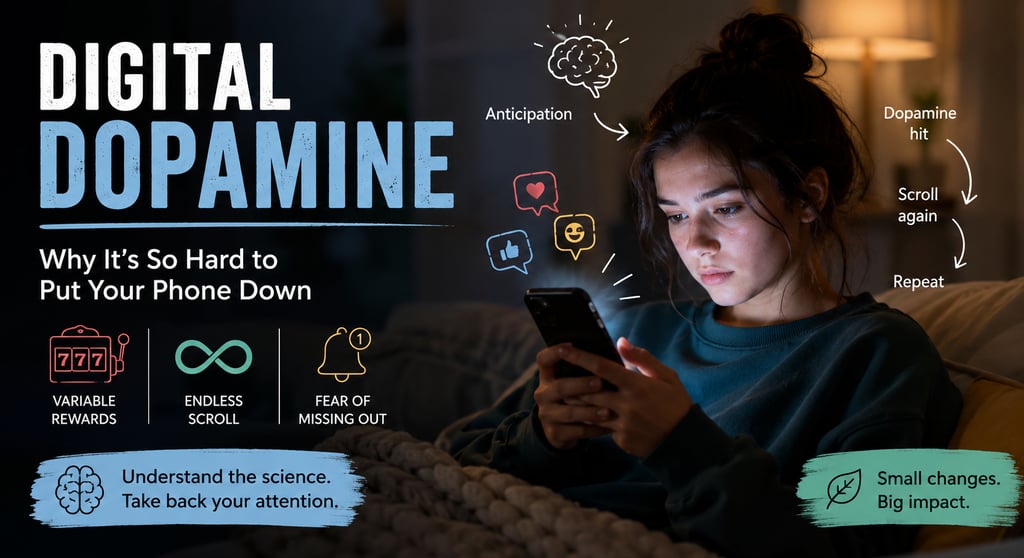
1. Variable Rewards
One of the most powerful drivers of behaviour is unpredictability.
This is similar to what psychologists call a variable reward schedule. Rewards that occur unpredictably often create more persistent behaviour than rewards delivered on a fixed schedule. Because you never know when something interesting will appear, your brain stays engaged and keeps checking.
Social media works in a remarkably similar way.
Every time you refresh a feed, open an app, or check a notification, you don't know what you'll find. It might be something boring, or it might be a funny video, an exciting message, or a post that sparks an emotional reaction.
That uncertainty keeps us checking.
2. Infinite Scroll and Auto-Play
Human beings naturally rely on stopping points.
A chapter ends. A television episode finishes. A newspaper page runs out of content.
These moments create opportunities for our brains to pause and decide what to do next.
Features such as infinite scrolling and auto-play remove those stopping cues. Content continues seamlessly, making it easier to remain engaged long after we intended to stop.
3. The Fear of Missing Out (FOMO)
Humans are social creatures.
For most of human history, staying connected to our community was important for safety, belonging, and survival. Our brains remain highly sensitive to social information.
Notifications, messages, likes, and updates tap directly into this system. They create a feeling that something important might be happening right now, encouraging us to check "just one more time."
The Impact on Mental Health and Attention
While smartphone use is not formally classified as an addiction in the DSM-5-TR, many people experience patterns of use that feel compulsive and difficult to control.
Constant exposure to highly stimulating, rapidly changing digital content may also make slower-paced activities feel less engaging by comparison.
Many people notice that after extended periods of scrolling, activities such as reading, studying, completing work tasks, or simply sitting quietly can feel surprisingly difficult.
At the same time, our brains are processing an enormous amount of information. News updates, messages, videos, advertisements, and social comparisons can create a state of ongoing mental activation that leaves us feeling drained rather than refreshed.
Why This Can Be Even Harder for People with ADHD
For many people with ADHD, these challenges can be amplified.
ADHD brains often seek novelty, stimulation, immediate feedback, and interesting rewards. Modern digital platforms are exceptionally good at providing all four.
This doesn't mean people with ADHD lack discipline or self-control. It means their brains are interacting with technology that has been specifically designed to capture attention through novelty and reward.
Understanding this interaction can help shift the conversation away from shame and toward practical strategies that actually work.
Three Realistic Ways to Reduce Digital Overload
The good news is that you don't need a week-long digital detox or a complete lifestyle overhaul.
In fact, extreme restrictions often backfire.
Small changes that introduce friction into the habit loop are usually far more sustainable.
Switch Your Phone to Grayscale
Our brains are naturally drawn to bright colours, especially attention-grabbing notification badges.
Turning your phone to grayscale removes much of the visual appeal and can make scrolling noticeably less rewarding.
Many people are surprised by how quickly their screen becomes less captivating.
Create Phone-Free Sanctuaries
Choose one or two places where your phone simply doesn't go.
Good options include:
The dining table
The bathroom
The bedroom
Family mealtimes
These physical boundaries help rebuild your ability to be present without constant digital stimulation.
Use the 20-Minute Delay
The next time you feel the urge to check your phone while working, studying, or spending time with someone, try saying:
"I can check it, but I'll wait 20 minutes."
You are not forbidding yourself from using your phone. You are simply creating a pause.
Often, the urge fades surprisingly quickly, allowing you to return to what you were doing.
A Final Reminder: Be Kind to Yourself
If you struggle with screen time, you are not alone.
Modern technology is competing aggressively for your attention. Entire teams of designers, engineers, and behavioural scientists work to make apps as engaging as possible.
Reducing screen time is rarely about becoming perfectly disciplined. It is usually about creating small boundaries that make intentional choices easier.
Progress does not require perfection.
Even small changes can help you feel more focused, present, and connected to the things that matter most.
Need Support?
If digital burnout, attention difficulties, anxiety, or overwhelm are affecting your wellbeing, speaking with a psychologist can help.
At Affirmative Minds Psychology, we work with children, adolescents, and adults to better understand patterns of attention, technology use, stress, and emotional wellbeing in a supportive and neurodiversity-affirming environment.
Contact us to learn more about how we can help.
This article is intended for educational purposes and reflects current psychological and neuroscientific understanding of attention, reward, and digital technology use.
References & Further Reading
Lembke, A. (2021). Dopamine Nation: Finding Balance in the Age of Indulgence. Dutton.
Hronis, A. (2025, June 17). Dopamine can make it hard to put down our phone or abandon the online shopping cart. Here's why. University of Technology Sydney / The Conversation.
Zhu, C., Li, S., & Zhang, L. (2025). The impact of smartphone addiction on mental health and its relationship with life satisfaction in the post-COVID-19 era. Frontiers in Psychiatry, 16, 1542040. https://doi.org/10.3389/fpsyt.2025.1542040
Affirmative Minds Psychology
Affirming identities and amplifying voices for a brighter tomorrow.
© 2024. All rights reserved.
Affirmative Minds Psychology is a neuro-affirming psychology clinic in Watsonia, offering counselling, therapy and assessments for children, teens, adults and families. We support clients across Bundoora, Greensborough, Macleod, Rosanna, Heidelberg, Viewbank and Melbourne’s northern suburbs. Services include ADHD assessment, Autism assessment, child psychology, adult psychology, couples counselling, cognitive testing and animal-assisted therapy.
Affirmative Minds Psychology acknowledges the Wurundjeri Woi-wurrung people as the Traditional Custodians of the land on which we work and live. We pay our respects to their Elders past, present and emerging, and honour their continuing cultural and spiritual connection to the land, waters, and community.
Affirmative Minds Psychology celebrates, values and includes people of all backgrounds, genders, sexualities, cultures, bodies and abilities.